
MY BOOK!
Blood, Guts & Black Pudding - Ireland's Dying Art of Blood as Food, by Kate Ryan
Blood, Guts & Black Pudding - Ireland's Dying Art of Blood as Food, by Kate Ryan
Blood, Guts & Black Pudding – Ireland’s Dying Art of Blood as Food, by Kate Ryan
From 10th September 2026, my new book, Blood, Guts & Black Pudding – Ireland’s Dying Art of Blood as Food, is now officially published and available to order through the Flavour.ie website, as well as Nine Bean Rows and from all good bookstores, published by Nine Bean Rows.
I began researching and writing about the social and cultural history of blood as food all the way back in 2019; never in my wildest dreams did I think back then that seven years’ later I would be sharing the news with you that I have now written a book about it! It’s the first complete text ever published on this incredibly engaging and, yes, even moving part of Ireland’s food history. For all its bloody and visceral connotations, at the end of the day, this is a story about the people of Ireland, their customs and traditions, and a foodway and culture that is fast disappearing. I am proud to have encapsulated all of that together in this one romp through Ireland’s food history spanning from the 1st Century to the present day!

About Blood, Guts & Black Pudding…
Blood.
The Irish have been dining on it for centuries and they love it.
It has sustained warriors in epic battles, staved off hunger, offered protection from bad luck and provided sustenance during winter; drawn from living animals and caught from dead ones, stuffed into guts and boiled until cooked or stirred into bloody porridges over turf fires. It’s in the mortar of castle walls. A Super Food.
Mostly we know it as the moody melange of blood and guts that completes the breakfast fry.
But this bloody food is older than potatoes, soda bread, whiskey, stout and coddle; an ancient food from a time when the Irish diet was one of milky, oaty, salty things. No surprise, then, that the best puddings are made when all four unite to form a singularly perfect food.
Yet Ireland’s ancient tradition of consuming the fresh blood of animals as food is in danger of disappearing forever, and with it an intricate nuanced foodway that ties together the history of Ireland, its people and their communities, rituals and recipe, craft and custom.
Blood, Guts & Black Pudding for the first time charts the complete history of Ireland’s great pudding tradition from pre-Christian times to the modern era, celebrating the many ways blood has been cooked, eaten and enjoyed, and questions what else is lost when the blood is gone.
Order your own author-signed copy today direct from Flavour.ie here!
Blood, Guts & Black Pudding is Published by Nine Bean Rows
Cover illustration by Chrissie Callaghan at Inky
Book Design by Matt Cox of Newman and Eastwood
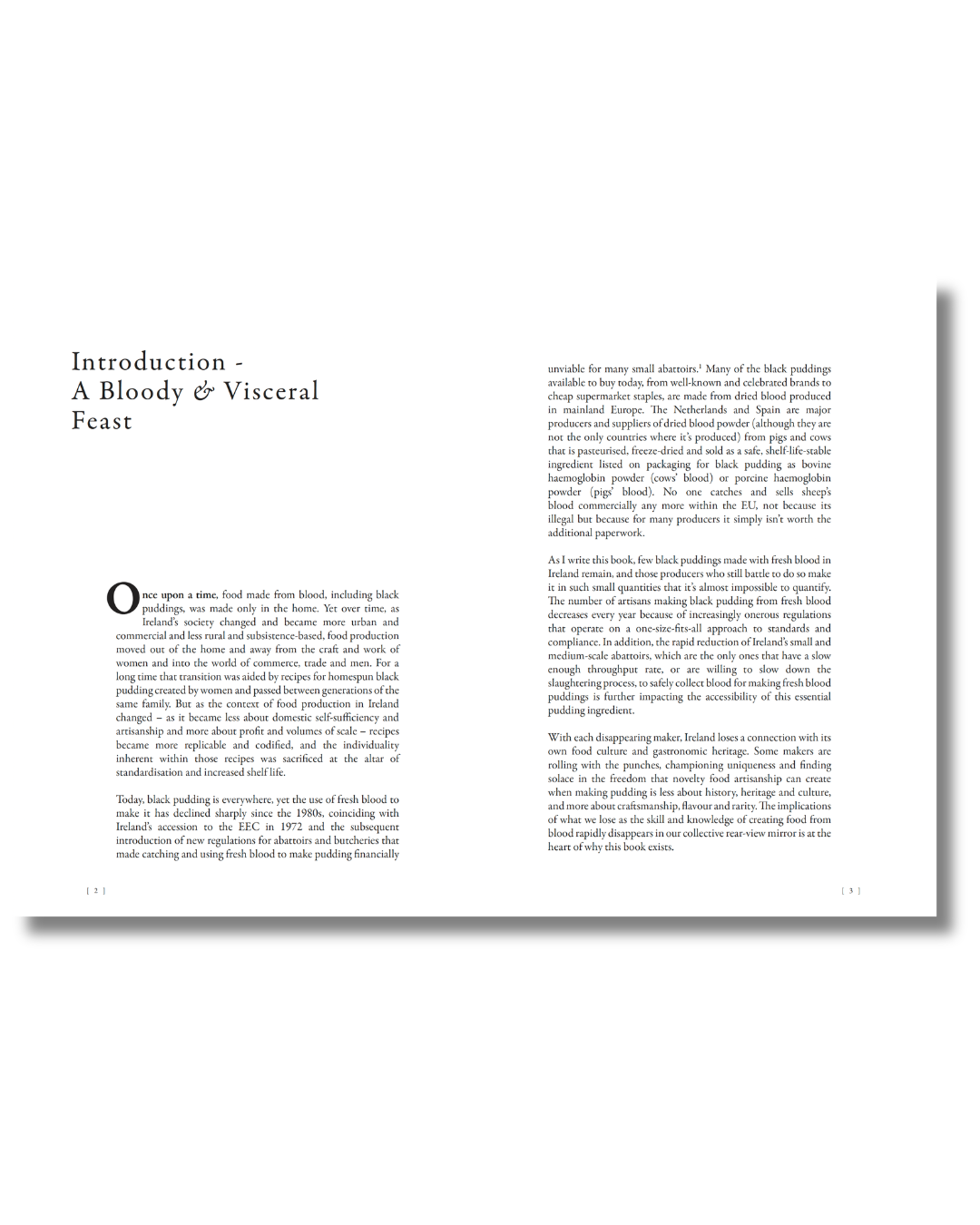

You’ll not be surprised at all to learn that, within the pages of Blood, Guts and Black Pudding, there are suggestions aplenty for the favourite ways in which people enjoy cooking and eating their black pudding and drisheen. I hope they inspire you to enjoy the simple pleasures of these foods in ways that are as old as time and as traditional as they come.
But puddings are foods that are as versatile as they are delicious, and many enjoy finding new ways with these old and ancient comestibles bringing the enjoyment of them up to date with modern tastes. From fine dining to casual eats, canapes to dishes inspired by far flung places, have some fun with these creations by great Irish chefs and food writers.
A quick and easy midweek meal that amps up the flavour courtesy of Clonakilty Blackpudding ispíni (sausages).

Serves 2
Heat a deep-sided frying pan on a medium heat. Add a splash of olive oil and the skinned sausages. Using a spatula, start breaking down the sausage meat into smaller pieces as it’s cooking, until the meat chunks are about the size of small marbles. Cook until the sausage meat begins to caramelise.
Add the garlic and fennel seeds and mix them through the meat. Cook for 1 minute, being careful not to burn the garlic. Add the tomato purée and mix to cover the sausage meat, garlic and fennel seeds. Cook for another 5 minutes.
Add the tinned tomatoes and water. Stir to combine, then increase the heat a little so the sauce starts to thicken and reduce. Add half of the finely chopped rosemary (add the stem for extra flavour). When the liquid has reduced by about half, stir in the red wine and reduce again.
Bring a large saucepan of water to a boil. Salt the water generously. Add the pasta and cook according to the packet instructions, until still slightly al dente. Drain and set aside.
When the sauce has thickened to a sticking consistency, check for seasoning. Fish out the rosemary stem, then stir through the rest of the fresh rosemary. Add the cooked, drained pasta, stirring to coat well. Serve on warmed plates, finishing with a grating of Cais na Tire cheese.
Rich black pudding combined with Irish black butter was a mad experiment that turned out delicious. Good for snaffling down with a glass of festive porter. Black butter is a condiment made from slow cooked apples and spices – delicious.
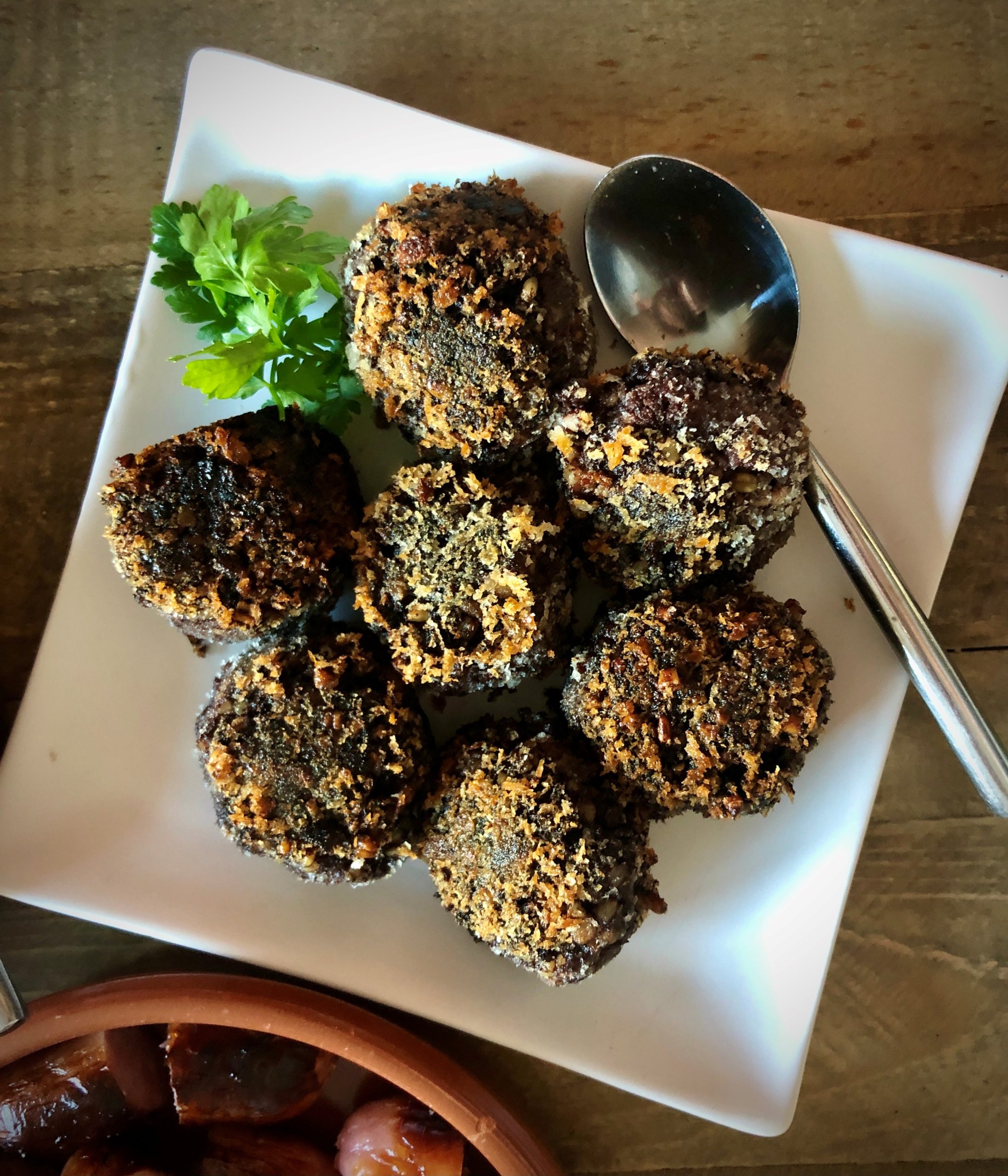
Crumble the black pudding into a bowl and gradually massage it into a softer, more malleable paste. Take about 1 tablespoon of the black pudding into your hands and gradually press and form into a ball. Repeat until finished.
Take each ball and, forming a cup shape with one hand, press the ball out to create a small bowl shape. Turn and shape, keeping the meat together. Take the time to do this, thinning and lengthening the walls of the ‘cup’ to create a space to drop in the black butter.
Using a spoon or a piping bag, put ¼ teaspoon of black butter in the cup. Start to close the sides of the cup over the conserve to form the black pudding into a ball again. Set aside and repeat until they’re all done. It’s a messy job! Chill the formed truffles in the fridge for at least 30 minutes.
Heat a good amount of oil in a deep-sided saucepan pan (or a deep-fryer) on a medium-high heat. Coat the black pudding truffles in panko breadcrumbs, then carefully drop into the hot oil to quickly deep-fry. When the breadcrumbs are golden brown, take the truffles out of the oil with a slotted spoon and drain on a piece of kitchen paper. Serve warm.
This recipe is from Darina’s wonderful cookbook, Irish Traditional Cooking and kindly reproduced with permission here.
Traditionally geese were killed around Michaelmas, Christmas and the New Year. Jack O’Keeffe, whose mother came originally from the Sliabh Lúachra area on the borders of Cork and Kerry, showed me how to make this pudding, which has been passed down in his family for many generations.
Serves 6–8
Sweat the onions in the butter over a low heat. Put the breadcrumbs and oats in a bowl. Add the salt, pepper, mixed spice, cinnamon and nutmeg, then add the onions and blood; mix and break up well. Stir in the chopped liver and mix again. Cook a tiny bit of the mixture and taste for seasoning.
If you are using the goose neck, turn it inside out and fill loosely with the mixture to allow for expansion. Knot the narrow end and sew the wide end to secure it tightly. Alternatively, fill the mixture into a pudding bowl, cover with a tight-fitting lid or a double thickness of greaseproof paper and tie as for a steamed pudding.
Bring a saucepan of cold water to the boil and add 1 teaspoon salt. Prick the goose neck pudding with a darning needle and add to the saucepan of boiling water. Bring back to the boil and then reduce to a simmer. Cook for 1–1½ hours on a very low heat with the lid on, pricking during the cooking time also. If using a bowl, steam the pudding for 1½ hours in a covered saucepan.
The goose pudding will keep for a week or so in the fridge, or it may be frozen. Cut in thick slices and fry gently in a little butter – delicious.
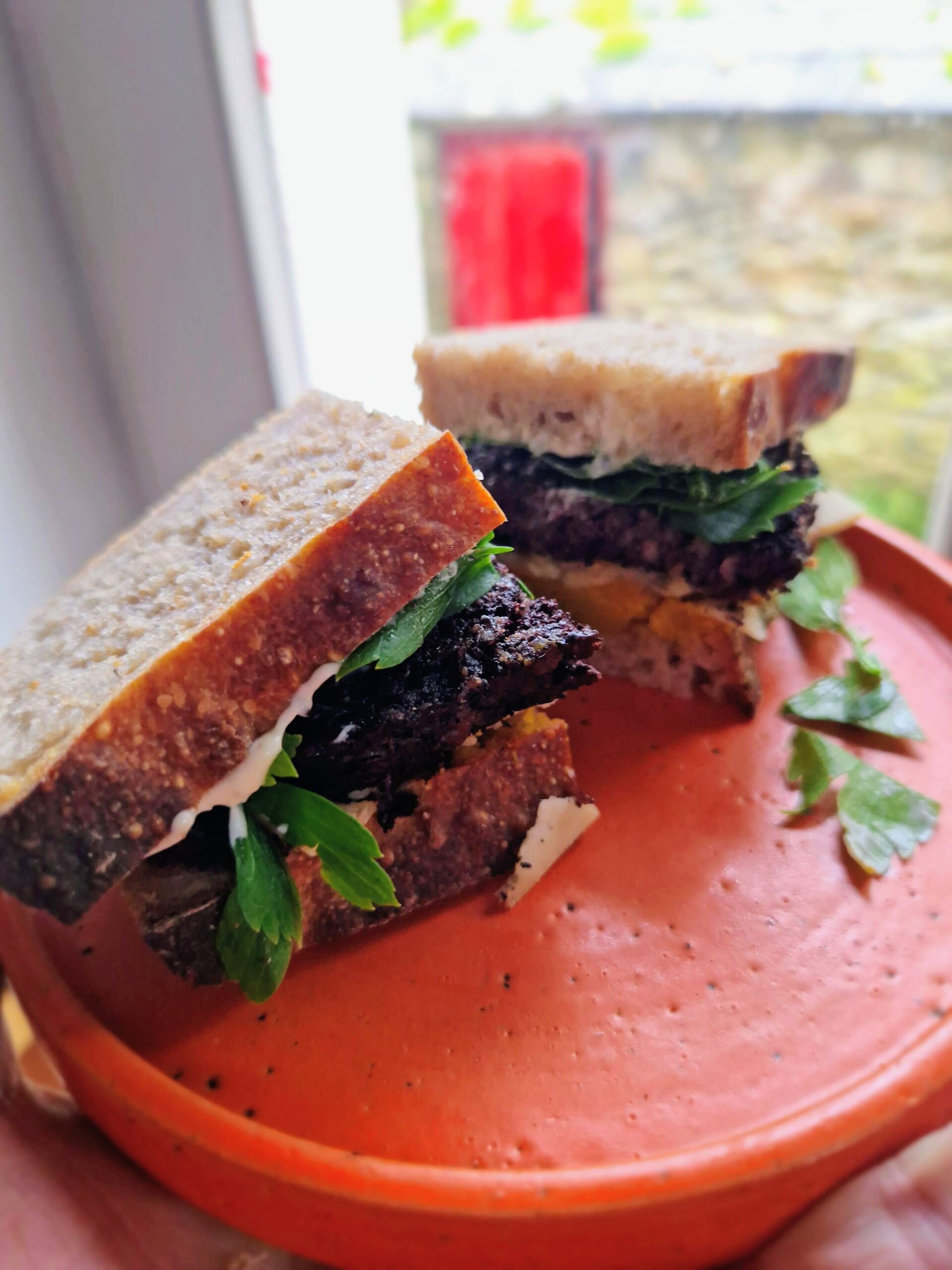
The bread: Our own sourdough, sometimes toasted, sometimes still fresh from the morning bake.
Something green: Leftover braised green veg (especially if gochujang has been involved) is always a winner. Or roasted brussels sprouts. Otherwise, I use lovage. A good BPS needs robust greenery.
Condiments: Essential. First, mayo for creamy richness – the simplicity of Ballymaloe mayonnaise, with flecks of cracked black pepper, works well here. A special mention for Builín Blasta’s legendary smoked onion mayo if you’re looking for a different flavour profile. Relish is needed too, bringing enough sweetness to set off this full-on umami bomb. A little heat is good and Folláin’s kimchi relish delivers here. Or try adding a few caramelised apple slices.
Pickles: Cut through everything with some crunchy, salty tang. Try Lolo’s Picklery pickled red onion and thank me later.
Cheese: Only blue cheese should go in a BPS. It’s a rule. Or my rule. My in-house blues are Cashel Blue and Young Buck, sometimes melted on the greens, sometimes crumbled into the mayo.
The main event: The rectangular shape of Inch House Black Pudding makes it an ideal sandwich pud. Other tin-baked favourites include Annascaul black pudding, Sneem black pudding and Fitzgerald’s Butchers black pudding from Fermoy. A special nod to those Chevaliers du Goûte-Boudin in Kanturk: McCarthy’s fat round slices are the perfect size for a blaa black pudding sandwich.
Not optional: A cup of tea and a proper napkin. This is going to get messy.
This recipe takes Irish black pudding and Spain’s love of pairing blood pudding with chickpeas, raisins and sherry, and bakes it all together into a golden pie.
Makes 1 small pie, but you can double this recipe and make it in a 26cm springform tin if you are cooking for a crowd.

For the pickled raisins:
To make the pickled raisins, put all the ingredients in a small stainless steel saucepan. Bring to a boil, then turn down the heat and simmer for 5 minutes. Remove the pan from the heat and allow to cool before storing in a sterilised jar in the fridge for up to three months.
To make the pie, preheat the oven to 180°C. Grease a 20cm cake tin.
Roll out the puff pastry sheet until it’s approximately 36cm x 28cm. Beat the egg with 1 tablespoon of water to make an egg wash. Brush the egg wash all over one side of the puff pastry. Line the oiled tin with the puff pastry sheet, egg washed side up, letting the edges hang over the side of the tin. Set aside.
Slowly cook the chopped onions in olive oil until soft and translucent. Pour in the chickpeas and garlic, then pour in the sherry and cook for 1 minute. Allow to cool slightly.
Remove and discard the casing from the ring of black pudding, then crumble the pudding into a medium bowl. Add the onion mix and the chopped parsley. Using your hands, combine the mixture until it’s homogenous. Press it firmly into the pastry-lined tin, then pull the edges of the pastry tightly up and over your filling, pinching the edges of the pastry together and discarding any excess pastry. Press down so the pastry top adheres well to the filling.
Brush a final layer of egg wash over the top of the pie, then bake in the preheated oven until golden brown and slightly risen. Remove the pie from the oven and let it cool slightly, then weigh down the top of the pie with a small plate and a tin of chickpeas. Refrigerate until needed.
To serve, heat by the slice in an oven until piping hot. Garnish with pickled raisins.
We have a habit of including black pudding in a wide array of recipes – as many as possible, really. We just adore it as a diverse ingredient, not least because Ireland boasts some of the finest BPs around, from Tipperary’s Inch House and Annascaul in Kerry to McCarthy’s of Kanturk and the ever-iconic Clonakilty, both from Cork. Use your favourite or opt for your local butcher’s unique iteration. To bring this to another level, we suggest seeking out Hugh Maguire’s ‘The Smokin’ Butcher’ Beechwood Smoked Black Pudding. Not only was it awarded three stars at the prestigious Great Taste Awards, but this product also clinched the overall Supreme Champion gong in 2017.
Makes 2
To serve:
Soft-boil two of the eggs by bringing a pot of water to the boil, then placing two eggs into it and cooking for 5 minutes to ensure runny yolks. Ready yourself with a bowl of iced water and transfer your eggs directly into it to stop the cooking and retain the desired yolk consistency. Leave to cool.
Heat the oil in your deep-fryer to 170°C. Because of the oval shape and the size of the eggs, try to ensure you are hitting the maximum limit line for the oil.
If necessary, remove and discard the casing from your sausages and black pudding. Place the meat in a bowl, then use a clean hand mix it all together until the sausage meat and black pudding have basically fused into one.
Prepare your pané station with three separate wide, shallow dishes: one for beating the remaining egg, another for the flour (stir through a little seasoning) and the third for the panko breadcrumbs.
Carefully remove the shells of the soft-boiled eggs by gently cracking them off a hard surface and peeling under a running tap. Return to the bowl of cold water until ready to shape.
Get a large square of cling film and spread half of the sausage–pudding mix on it in an even layer roughly 25cm square. Place your peeled egg in the middle, then pull the corners of the cling film together to gently and evenly wrap the egg in the meat. Take your time to be precise here.
Now cover the meat-wrapped egg evenly in flour, then submerge quickly into the beaten egg before generously coating in the panko.
Deep-fry in the hot oil for 7–8 minutes, until golden in colour, turning each egg every couple of minutes to ensure they cook evenly. Drain and place on a wire rack set over a baking tray lined with kitchen paper to absorb any excess oil, then season with flaky sea salt.
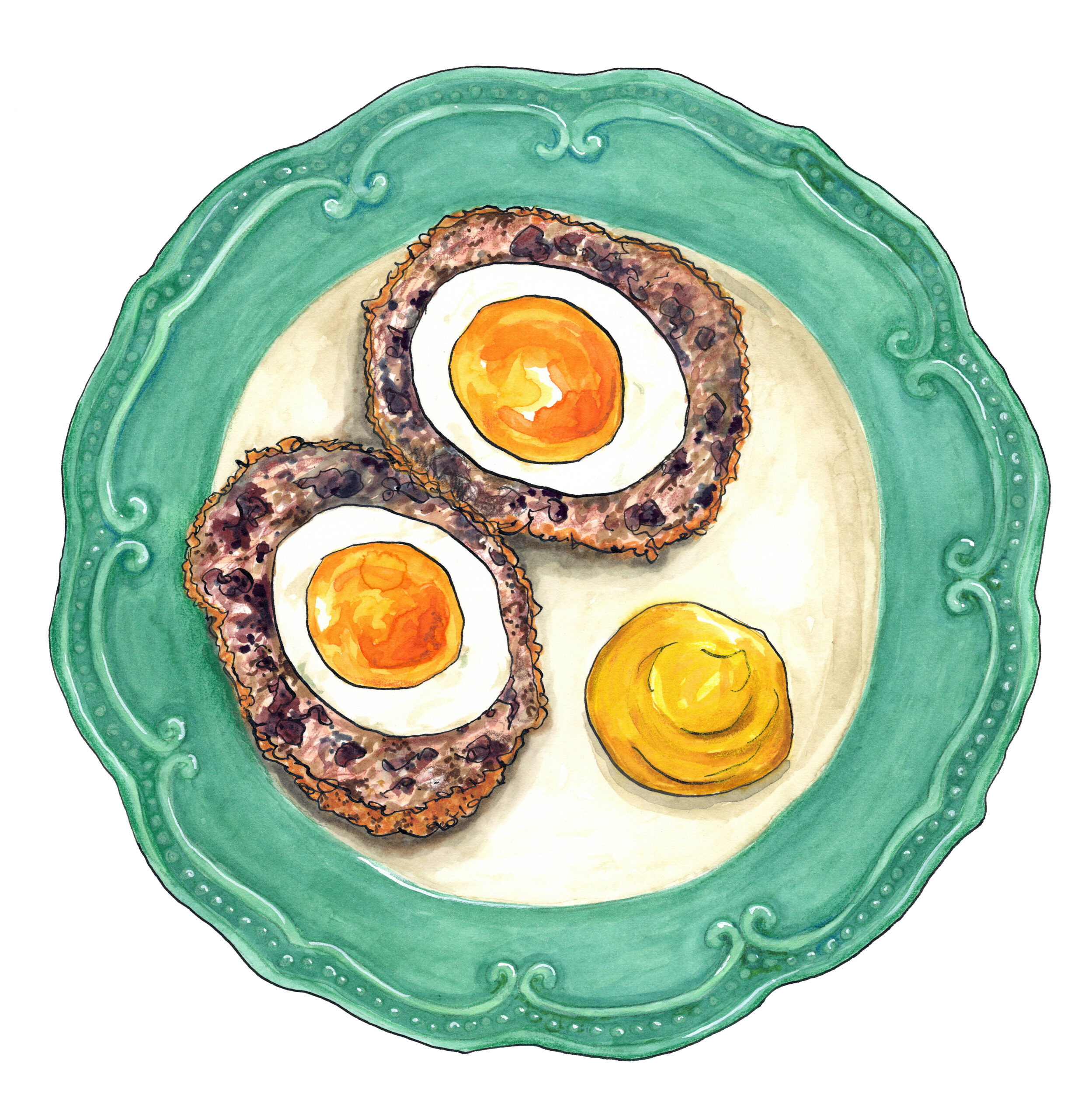
To serve, cut in half and enjoy with a bit of fiery mustard, a dollop of sharp piccalilli or chutney and some dressed green leaves.
I dive into the history of this fresh blood pudding in Blood, Guts & Black Pudding. It was the first in the country to gain a Protective Geographic Indicator (PGI) before it was handed back to the powers that be in the EU, and it disappeared forever…
This recipe came from an online source, which can be found here: https://www.meatsandsausages.com/sausage-recipes/blood/uk/timoleague-brown-pudding

Soak the cereal in the fresh pork blood the night before preparation and keep in a cooler.
Grind the meat with the onions through a 6mm (¼in) plate. Mix the meat with the blood and spices, then stuff into 40mm hog casings. Cook in water at 80°C (176°F) for 35 minutes. Cool and refrigerate.
This is the quintessential way to eat drisheen (Cork) or packet (Limerick).
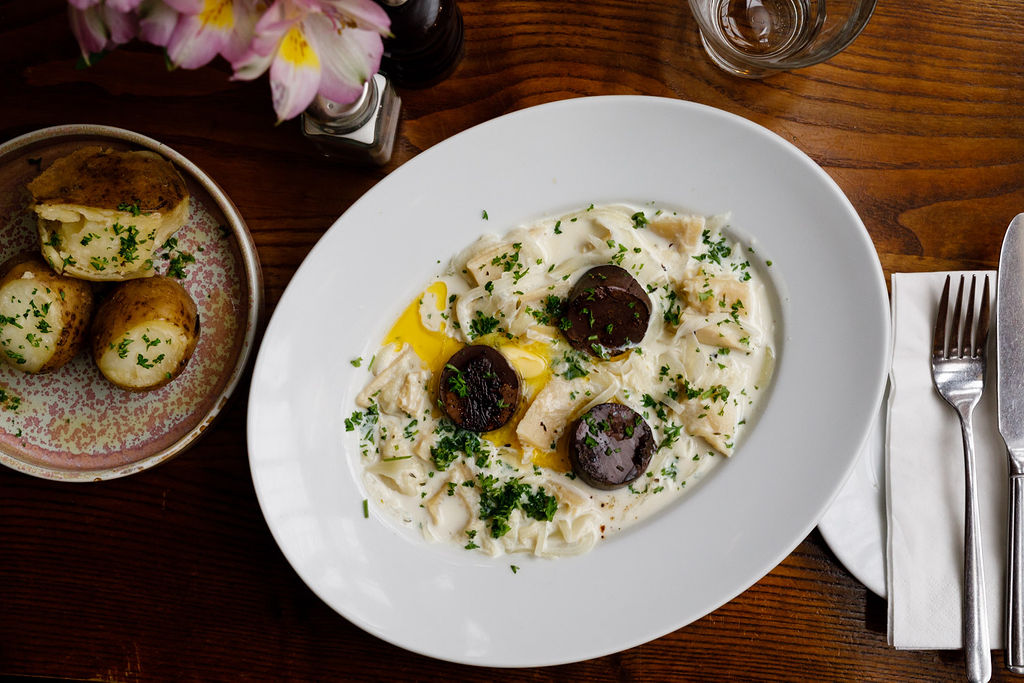
Put the tripe in a saucepan with enough water to cover. Put the lid on and cook for 8–10 minutes.
Discard the cooking liquor, then add the onion to the tripe and cover with cold milk. Simmer gently for 1 hour, until the tripe is tender.
Strain off the milk into a fresh saucepan and thicken with some roux. Season with salt and plenty of pepper. Strain the milk back into the saucepan with the tripe. Add peeled and sliced rounds of drisheen and heat through.
Check the seasoning (it will take quite a bit of pepper) and serve with a side of floury potatoes and slice of buttered white bread.
This dish is designed to be eaten as a snack or canapé before the main dish. The date purée makes more than you need, stores well in a fridge and is also excellent with cheese and terrines. The crisped bacon and pastry give contrasting texture to the soft drisheen.
Not unlike Darina Allen’s account of buying drisheen in Cork’s English Market, where a microcosm of Cork life was played out before the counter, Murray had a similar experience when he went to O’Reilly’s to buy his drisheen to make this recipe: ‘I was buying drisheen in the market and got chatting to the lady behind the counter and another of her customers – two ‘Pure Cork’ women! One swore by the traditional method cooked in milk, the other suggested frying it with a little smoked bacon fat; they had a good-humoured argument over what I should do with it.’
First make the date purée – this adds acidity and sweetness. Toast 30 black peppercorns, 2 whole star anise and 2 teaspoons ground ginger in a dry frying pan on a medium heat. Add 100g muscovado sugar, 300ml white port and 150ml sherry vinegar. Bring to a boil and simmer for 5 minutes, making sure sugar has dissolved. Put 700g pitted Medjool dates in a deep saucepan and strain the port mixture over. Add enough water to cover the dates and cook until soft. Blitz well, then season with salt and a little more sherry vinegar.
Brush slices of brick or filo pastry with butter, sprinkle with thyme and sea salt and bake between two baking trays to keep flat.
Fry the bacon until crispy and set aside. Cook slices of drisheen in the bacon fat until warmed through.
Serve the drishen with a piece of crispy bacon on top and a dab of the date puree, then sandwhich between two pieces of the baked pastry.
Harrison Sharpe is head chef at Elbow Lane Smokehouse & Brewery. As with all Market Lane restaurants (Elbow Lane Brewery & Smokehouse, Market Lane, ORSO, Goldie and Castle Restaurant Blackrock), sustainability is at the heart of Elbow Lane, which includes ‘nose-to-tail’ dining.
‘I’m no stranger to offal, which means I’ve an acquired taste for acquired tastes, but drisheen had me intimidated!’ Harrison says. ‘I headed to O’Reilly’s and asked the lady at the counter to recommend preparing it. She gave me three options: boiled, fried in butter, or cooked in a white sauce with lots of onions. This gave me some ideas, and I headed back to the restaurant to experiment. The result is delicious – a modern version of the three ways advised to cook drisheen at the stall. This is a weekend project, perfect for a lazy Sunday.’
Harrison recommends buying fresh lasagne sheets, unless confident in making your own pasta.
Serves 4
To prepare the drisheen:
For the stock:
For the filling:
For the brown butter:
To assemble:
Pierce the drisheen all over, then put it in a ziplock bag with enough buttermilk to cover. Refrigerate overnight.
The next day, rinse off the buttermilk. Mix the salt and water together until the salt has dissolved to make a brine. Put the drisheen in a container with half of the brine for 2 hours. Drain and rinse the drisheen, then put it in a bowl with fresh water. Leave for 1 hour.
Drain the water, rinse again and soak in the remaining brine for 1 hour.
Drain and soak in fresh water for a final tine for 1 hour.
Meanwhile, to make the stock, simply put all the ingredients in a large pot. Bring to a boil, then reduce the heat and simmer for 30 minutes.
Fill a medium saucepan with water and bring to the boil. Turn the heat down to a simmer, then add the cured drisheen and cook for 2–3 minutes. Remove from the saucepan and put in a bowl of ice water. When it has cooled, transfer the drisheen to the stock and simmer gently for 10 minutes. Remove from the heat and allow to cool, then chill in the refrigerator.
To make the ravioli filling, roughly chop the chilled drisheen. Melt the butter in a pan on a medium heat. When the butter starts to foam, add the onion and cook until translucent. Add the vinegar and reduce by two-thirds, then add the cream. Bring to a boil until thickened. Add the chopped drisheen along with the Parmesan, sage, nutmeg and some salt and pepper. Set aside to cool. Whisk the egg white to soft peaks, then combine with the drisheen mixture.
To make the brown butter, put the butter in a saucepan and cook on a medium-low heat, stirring until all the water has evaporated and the butter starts to foam and smell nutty. Cook until the bubbles subside and the butter has specks of brown. Pour into a bowl with the remaining ingredients.
To make the ravioli, work in batches of four ravioli at a time. Lay the pasta sheets on a lightly floured surface. Scoop 1 teaspoon of drisheen filling onto the sheet, leaving 2cm around the edges and 5cm between each scoop.
Lightly brush a little water between the filling, then put another sheet on top, removing as much air as you can. Punch out with a ravioli stamp and set aside on a lightly floured tray while you make the rest.
Bring a saucepan of well-salted water to a boil. Gently drop in the ravioli to cook for 3 minutes. Remove using a slotted spoon, then add to the brown butter and toss to coat.
Serve with grated Parmesan.
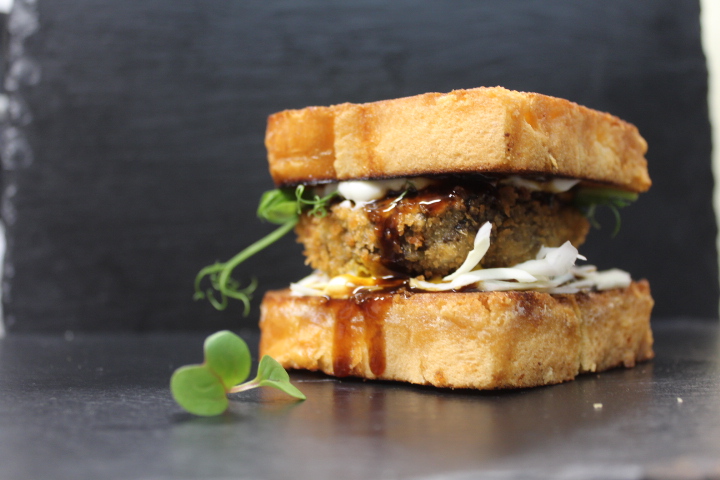
Mike McGrath is head chef at Cork’s iconic Japanese takeaway, Miyazaki. For a food festival in the city a couple of years ago, Mike decided to challenge himself to put a modern twist on how drisheen, a blood sausage synonymous with Cork City, is served and eaten. Inspired by the Japanese flavours he plays with every day, McGrath created a twist on a tonkatsu sandwich and it proved to be a popular bite during the festival. Mike has kindly recreated his drisheen sando for Blood, Guts & Black Pudding.
Makes 2 sandos
To pané and fry:
To assemble:
Remove the skin from the drisheen and discard, then put the drisheen in a blender with the soy sauce, mirin and sake and blitz until smooth.
Melt the butter in a pan on a medium heat. Add the onion and oyster sauce and caramelise until golden brown. When it has reduced by half, add the whiskey and cook for 3 minutes, until the alcohol has evaporated.
Add the blended ingredients to the pan and cook for a further 10 minutes on a low heat. Add the panko breadcrumbs and mix thoroughly.
Remove the pan from the heat, then spread the mixture out to cool on a flat tray lined with parchment – it should be about 2.5cm thick. Leave to cool fully, then transfer to the fridge to chill for 1 hour.
Set up a pan for deep-frying. Use a high-sided frying or saucepan and add enough sunflower oil to deep-fry the sliced drisheen. Slowly and careful heat the oil to a high temperature for frying. Test by dropping in some panko breadcrumbs – if they start to sizzle, it’s ready to use.
While the oil is heating up, put some flour in a bowl and season with salt and a generous pinch of white pepper. Put the eggs in a second bowl and gently beat. Put the breadcrumbs in a third bowl.
Cut the drisheen into sando-sized slices, then coat first with flour, then the beaten egg, then the breadcrumbs. Deep-fry for 2 minutes, until the breadcrumbs are glistening and golden, then remove from the oil using a slotted spoon or spider and place on kitchen paper to remove any excess oil so the drisheen stays crispy.
Pan-fry the brioche slices in salted butter, then assemble your sando is a dollop of mustard, tonkatsu sauce, Kewpie mayo, shredded white cabbage and the deep-fried drisheen.
To make the béchamel sauce, put the milk in a saucepan with the carrot, onion, thyme, some parsley stalks and salt and pepper. Bring slowly to the boil and simmer for a few minutes to extract the flavours. Strain, discard the vegetables and herbs, bring the milk back to the boil, thicken with the roux and season with salt and pepper.
Add 1 tablespoon finely chopped tansy to your béchamel sauce, stir through and heat until just below simmering point. Serve over just-cooked drisheens or with black pudding, baked potatoes, pasta, boiled bacon or ham. It’s a great combination for a change.
web design and development by the designer of things